
I still remember standing on a rooftop beside an old package unit with a fellow technician. The compressor nameplate was faded, the model number was barely readable, and the customer wanted to know one thing:
“How many tons is this unit?”
Normally, that’s an easy question. You check the model number, look at the manufacturer’s data, and find the capacity.
But this unit was old. The data sticker was damaged by years of sun and rain. The only readable information left was the voltage, refrigerant type, and one important number: LRA (Locked Rotor Amps).
That’s when we started estimating the tonnage using LRA values.
Over the years, I’ve seen many HVAC technicians, contractors, and equipment buyers use LRA as a quick reference when identifying compressor size. However, I’ve also seen many people make the mistake of assuming there is an exact formula that converts LRA directly into tons.
The reality is a little more complicated.
If you’ve ever wondered how LRA relates to air conditioning tonnage, this guide will explain it in simple terms and help you avoid common mistakes.
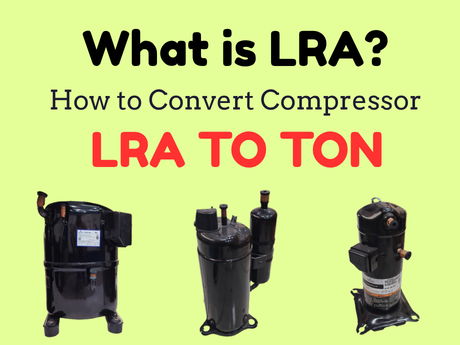
What Does LRA Mean in HVAC?
LRA stands for Locked Rotor Amps.
It refers to the maximum amount of electrical current a compressor motor draws when it first starts and the rotor is not yet moving.
That startup moment lasts only briefly, but the current spike is much higher than normal running amps.
Think of it like pushing a heavy car from a complete stop.
The hardest part is getting it moving initially. Once it starts rolling, it requires less effort. HVAC compressors work similarly.
When I first checked a compressor label myself, I confused:
- RLA (Rated Load Amps)
- FLA (Full Load Amps)
- LRA (Locked Rotor Amps)
That mistake taught me quickly that these numbers serve completely different purposes.
LRA specifically measures startup electrical demand.
Why HVAC Technicians Use LRA to Estimate Tonnage
Normally, the easiest way to identify AC tonnage is:
- Manufacturer model number
- BTU rating
- Nameplate cooling capacity
But in older HVAC systems, labels are often:
- Faded
- Damaged
- Missing completely
That’s when technicians sometimes use compressor LRA values to estimate system size.
I once saw this happen during a rooftop package unit inspection. The unit label was unreadable because of years of sun exposure. The technician checked the compressor LRA instead and made a rough tonnage estimate within minutes.
It wasn’t perfect, but it was accurate enough for troubleshooting and planning repairs.
The Basic LRA to Ton Conversion Formula
Here’s the common field estimation formula many technicians use:
\text{Estimated AC Tons} \approx \frac{\text{LRA}}{60}
This formula is not official manufacturer engineering data.
It’s simply a rough HVAC field estimation method.
Different compressor designs, refrigerants, voltages, and efficiency ratings can change the numbers significantly.
Still, for quick estimates, it can help.
Simple LRA to Ton Calculation Example
Let’s say a compressor label shows:
- LRA = 120
Using the formula:
\text{Estimated Tons} \approx \frac{120}{60}=2\ \text{tons}
That means the HVAC system is approximately a 2-ton air conditioner.
Again, this is only an estimate.
I’ve personally seen systems where the estimate was slightly off because compressor efficiency varies between manufacturers.
Still, it usually gets you close enough for identification purposes.
Another Quick HVAC Example
Suppose you inspect an older compressor with:
- LRA = 180
Estimated tonnage:
\text{Estimated Tons} \approx \frac{180}{60}=3\ \text{tons}
So the system is likely around 3 tons.
This is one reason experienced HVAC technicians memorize approximate LRA ranges.
After seeing enough compressors, they can often estimate tonnage almost instantly.
Why This Formula Is Not Always Accurate
This is the part many beginners misunderstand.
LRA does not directly determine cooling capacity.
Two compressors with similar LRA values may have:
- Different efficiency ratings
- Different refrigerants
- Different compressor technologies
- Different operating voltages
That’s why you should never size a replacement HVAC system using only LRA.
I once watched someone order the wrong compressor because they relied only on startup amps without checking model specifications.
The replacement physically fit the unit but didn’t match the original cooling performance correctly.
That mistake delayed the repair and increased costs.
Factors That Affect LRA Values
Several things influence compressor startup amperage.
1. Compressor Type
Different compressors draw different startup currents.
Examples:
- Scroll compressors
- Rotary compressors
- Reciprocating compressors
Each behaves differently during startup.
Scroll compressors often have smoother startup characteristics compared to older reciprocating designs.
2. Voltage
Voltage affects amperage significantly.
For example:
- 208V systems
- 230V systems
- 460V systems
The same tonnage unit can show different amp characteristics depending on voltage configuration.
That’s why experienced technicians always check electrical ratings carefully.
3. Refrigerant Type
Older R22 systems may behave differently compared to:
- R410A
- R32
- R134a systems
Modern refrigerants and compressor technologies change electrical performance characteristics.
4. Compressor Efficiency
High-efficiency compressors sometimes draw lower amps while delivering similar cooling capacity.
That’s another reason why LRA estimation should never replace manufacturer specifications.
Typical HVAC LRA Ranges by Tonnage
Here’s a rough field reference table many technicians use.
| Approximate Tons | Typical LRA Range |
|---|---|
| 1 Ton | 40–60 |
| 1.5 Ton | 55–75 |
| 2 Ton | 70–120 |
| 3 Ton | 120–180 |
| 4 Ton | 170–230 |
These numbers vary by manufacturer and compressor design.
Still, this chart can help identify unknown systems quickly.
I actually keep similar notes saved on my phone because older HVAC equipment often has unreadable labels.
Tools That Help Identify HVAC Tonnage
Over time, I realized relying only on amp readings isn’t the smartest approach.
Now I usually cross-check information using:
- Manufacturer model lookup websites
- HVAC apps
- Digital clamp meters
- Compressor datasheets
Some technicians also use:
- Copeland Mobile App
- Danfoss Ref Tools
- Emerson compressor databases
These tools make identification much easier compared to old-school guessing methods.
Common Mistakes People Make With LRA Calculations
I’ve seen beginners make the same mistakes repeatedly.
Confusing LRA With Running Amps
This is extremely common.
LRA measures startup current.
Running amps are completely different.
Using the wrong number leads to inaccurate calculations.
Assuming the Formula Is Exact
The formula is only a rough estimate.
It’s not an engineering-grade sizing method.
Always verify using manufacturer data whenever possible.
Ignoring Compressor Replacement History
Sometimes the compressor inside the unit is not original.
I’ve seen old HVAC systems where the outdoor unit was 3 tons but someone installed a different replacement compressor years later.
That changes everything.
Forgetting About Efficiency Ratings
Modern inverter systems behave differently compared to older fixed-speed compressors.
Startup characteristics vary widely.
That’s why newer HVAC systems may not follow traditional estimation patterns perfectly.
When Should You Use LRA to Ton Conversion?
This method is most useful when:
- Unit labels are missing
- You need quick field estimates
- Inspecting old equipment
- Troubleshooting compressors
- Identifying approximate system size
It’s especially helpful during:
- Service calls
- Used equipment inspections
- Compressor replacement planning
But for:
- New system sizing
- Load calculations
- Exact replacements
You should always use official manufacturer specifications.
My Personal Advice After Working Around HVAC Systems
After spending time around HVAC technicians and troubleshooting real systems, here’s something I learned quickly:
Field experience matters just as much as formulas.
You can memorize every HVAC equation online, but real-world systems rarely behave perfectly.
Sometimes labels are missing, previous repairs changed components & amp readings don’t match expectations because of hidden issues.
That’s why experienced technicians combine:
- Electrical readings
- Visual inspection
- Compressor sounds
- Pressure readings
- Temperature measurements
The LRA formula is just one small piece of the puzzle.
Useful?
Absolutely.
Perfect?
Not even close.
Final Thoughts
The LRA to ton conversion formula is one of those practical HVAC shortcuts technicians use when exact system information isn’t available. It’s not meant to replace manufacturer specifications, but it can provide a quick estimate when dealing with older or damaged equipment.
Once you understand what Locked Rotor Amps actually represent, the formula becomes much easier to use correctly. The important thing is remembering that LRA measures startup current — not cooling performance directly.
If you work around HVAC systems regularly, learning simple field estimation methods like this can save time and help during troubleshooting situations. Just don’t rely on it blindly without checking other system details.
The more HVAC systems you see in real life, the easier these numbers start making sense.