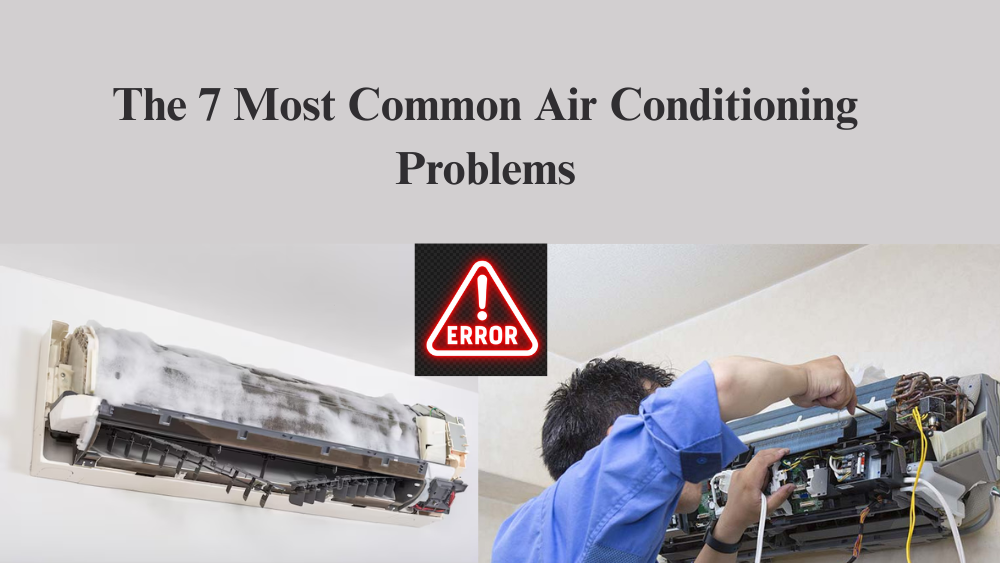
Last July, I woke up at 3 AM sweating through my sheets because my AC decided to just… stop. Not break dramatically. Just quietly give up while blowing what felt like room-temperature air at me all night. The 7 Most Common Air Conditioning Problems.
I remember lying there thinking, “Great, now I have to deal with a technician, a bill, and probably a week of sleeping like garbage.”
Turns out, it wasn’t nearly as bad as I imagined. Once I actually understood what was going on, most AC problems are pretty predictable. They show up again and again, across different units, different homes, different climates.
So I started paying attention. I talked to a couple of HVAC guys who came out over the years, read through manuals I never bothered opening before, and honestly just messed around with my own unit more than I probably should have.
Here’s what I’ve learned about the seven problems that come up constantly — and what actually helps.
1. The AC Is Running But Not Actually Cooling Anything
This one confused me the most the first time it happened. The unit was on, the fan was spinning, air was coming out of the vents… it just wasn’t cold.
Turns out this is almost always one of two things: low refrigerant or a dirty condenser coil.
The refrigerant issue caught me off guard because I assumed refrigerant just runs out like gas in a car. It doesn’t. AC systems are sealed — if refrigerant is low, that means there’s a leak somewhere. Topping it off without fixing the leak is basically a temporary band-aid. I learned that the expensive way after paying for a “refill” that lasted about six weeks.
The dirty coil thing is way more common and way cheaper to fix. If the outdoor unit’s coils are caked in dust, pollen, or grass clippings (mine had actual spider webs woven into it once), the whole system struggles to release heat properly.
What actually helped:
- I now hose down the outdoor unit’s coils every spring before the heat really hits.
- I turn off power to the unit at the breaker first, obviously.
- A gentle garden hose spray, not a pressure washer — those fins bend way too easily.
2. Weird Noises That Weren’t There Before
AC units aren’t silent, but there’s a difference between “normal hum” and “this sounds like it’s about to explode.”
I had a rattling sound for weeks that I just ignored because, honestly, I didn’t want to deal with it. Turned out to be a loose panel screw on the outdoor unit. Ten minutes with a screwdriver fixed it.
But not all noises are that innocent. Here’s roughly what different sounds tend to mean, based on what I’ve experienced and what techs have told me:
- Rattling — loose panels, debris caught in the fan, or loose screws.
- Squealing — usually a fan motor bearing or a belt issue (more common in older systems).
- Clicking at startup/shutdown — normal, that’s the relay switching.
- Banging or clanking — this is the scary one. Often a broken or loose part inside the compressor. Don’t ignore this.
- Hissing — could be a refrigerant leak, and that’s not a DIY situation.
If it’s rattling, check for loose stuff first. If it’s hissing or banging, that’s when I actually call someone instead of poking around myself.
3. Water Pooling Around the Indoor Unit
The first time I saw water dripping from my indoor unit onto the floor, I panicked a little. My mind jumped straight to “the whole thing is broken.”
Nope. It was a clogged condensate drain line. ACs pull moisture out of the air, and that water is supposed to drain out through a small tube. Over time, algae and gunk build up inside that tube and clog it.
The fix that worked for me:
- Locate the condensate drain line (usually a PVC pipe near the outdoor unit or from the indoor air handler).
- Turn off the unit.
- Use a wet/dry vacuum on the outside end of the pipe to suck out the clog. I used a shop vac I already had for garage cleanup.
- Pour a mix of water and a little vinegar down the access point every couple of months to keep algae from building back up.
This alone saved me a service call. Not every clog is this simple, but a lot of them are.
4. The Thermostat Is Lying to You
I genuinely didn’t think about this until a friend mentioned it. Your AC can be working perfectly fine, and the real problem is the thermostat giving it bad information.
I had an old mechanical thermostat that was just… inaccurate. It thought the room was 74°F when it was actually closer to 78°F. So the AC would shut off early, thinking the job was done.
Switching to a smart thermostat (I went with a Google Nest, though an Ecobee works just as well) actually fixed more “cooling problems” than I expected. Not because it’s magic, but because it reads the room correctly and doesn’t have worn-out internal components second-guessing the temperature.
If your AC seems to shut off too early or run non-stop without reaching the set temp, check the thermostat placement too. Mine was near a window getting direct afternoon sun, which was throwing off the readings completely.
5. Airflow That Feels Weak in Certain Rooms
For a while, my bedroom was always warmer than the rest of the house. I assumed it was just “how the house is built.”
It wasn’t. It was a dirty air filter combined with a partially closed vent damper I didn’t even know existed behind a vent cover.
Quick checklist that helped me troubleshoot this:
- Replace or clean the air filter. I check mine monthly during peak summer and honestly, I was shocked how dusty it gets in just a few weeks.
- Check that furniture or curtains aren’t blocking vents (mine had a bookshelf half-covering one).
- Look for dampers inside the ductwork near vents — some can be manually adjusted.
- If one room is consistently worse, it might just need better insulation, not more cooling power.
Filters are the cheapest fix in this entire list, and probably the most overlooked. A clogged filter restricts airflow so much that it makes the whole system work harder for worse results.
6. The AC Turns On and Off Constantly (Short Cycling)
This one’s sneaky because it doesn’t feel “broken” at first — it just feels inefficient. My unit was cycling on and off every few minutes instead of running a full cooling cycle.
This is called short cycling, and it usually points to one of these:
- An oversized unit for the space (common in older homes with mismatched replacements)
- A dirty air filter restricting airflow
- Low refrigerant
- A failing thermostat or sensor
In my case, it was a combination of a dirty filter and a thermostat sensor issue. Once I cleaned the filter and replaced the batteries in my old thermostat (yes, seriously, dying batteries can cause weird sensor behavior), it stopped almost immediately.
If cleaning the filter doesn’t help, this is one where I’d actually recommend getting a professional opinion, since short cycling wears out the compressor faster over time.
7. High Energy Bills With No Obvious Reason
This is the problem that doesn’t announce itself loudly. The AC seems fine, the house feels cool enough, but then the electric bill shows up and it’s noticeably higher than last summer.
A few things I’ve found actually move the needle here:
- Old units (10+ years) lose efficiency gradually, so you don’t notice the decline day to day.
- Leaky ductwork loses cooled air before it even reaches the room. I had this in my attic ductwork and didn’t know until a tech pointed out gaps in the seams.
- Running the AC at a much lower temperature than needed “just in case” — a smart thermostat schedule fixed this for me more than any hardware change did.
I started tracking my energy usage through my utility company’s app, and noticing patterns actually helped more than I expected. Once I sealed a few duct joints with mastic sealant (not just tape — regular duct tape actually fails over time despite the name), my bill dropped noticeably the next month.
Mistakes I’d Tell Anyone to Avoid
- Ignoring weird noises because the AC still “works.” Small issues turn into expensive ones.
- Skipping filter changes because it seems minor. It’s genuinely one of the biggest factors in performance.
- Assuming refrigerant just “runs low” naturally. If it’s low, something’s leaking.
- Using a pressure washer on outdoor coils. I bent mine slightly the first time and it affected airflow.
- Waiting until peak summer to get maintenance done. Every HVAC tech I’ve talked to says spring is way less busy and cheaper.
Final Thoughts
None of this stuff felt obvious to me until I actually went through it. AC problems have a way of feeling mysterious and expensive right up until you understand the pattern behind them — and honestly, most of it comes down to airflow, drainage, and a few sensors doing their job correctly.
I’m not saying skip the professional when you genuinely need one — refrigerant leaks, compressor issues, and electrical problems are not the place to experiment. But a good chunk of what makes an AC “act up” is stuff you can catch early with a little attention.
If your unit’s acting weird right now, start with the filter and the outdoor coils. It sounds too simple, but that’s genuinely where most people find their answer.