I got a text at 7am from a bar owner I’ve worked with for years: “Cooler’s warm again, third time this month, I’m losing my mind.” I already had a guess before I even walked in, because I’d seen this pattern before with an EMZ90HLC. That compressor has a personality, and once you’ve worked on a few of them, you start recognizing their quirks almost like you’d recognize a car that always makes a weird noise before it stalls.
If you’re dealing with an Embraco EMZ90HLC-1PH running on R134a and something’s acting up — short cycling, not cooling, humming and tripping, whatever it is — I want to walk you through what I’ve actually seen with these units, the mistakes I made early on, and how I’d approach it if it were sitting in front of you right now.
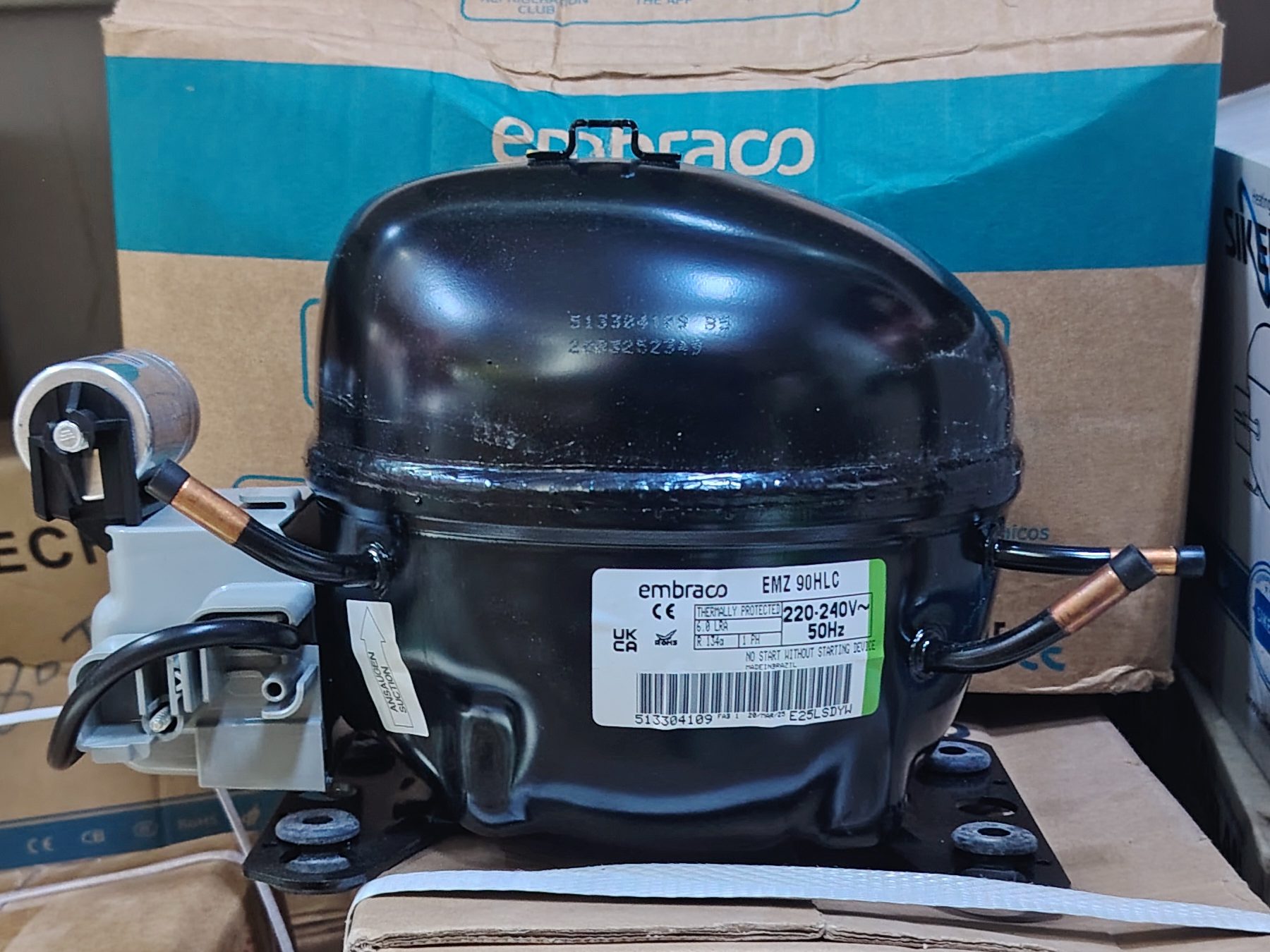
Quick Rundown: What This Compressor Is Actually Built For
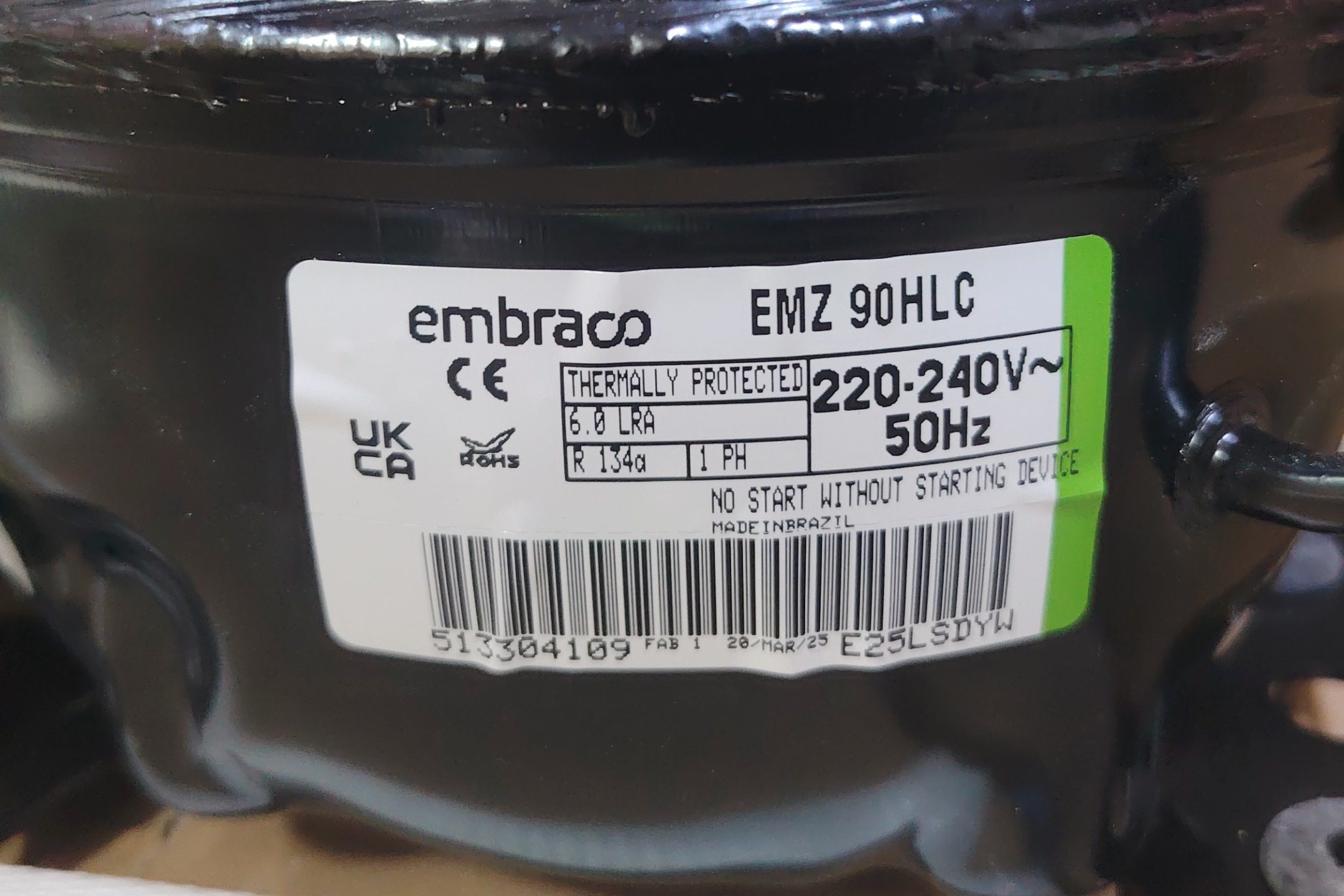
The EMZ90HLC is one of Embraco’s low back pressure (LBP) compressors, part of their older “EM” line before a lot of the newer Embraco/NIDEC units took over. You’ll find these in reach-in freezers, small commercial ice cream cabinets, under-counter freezer units, and some bottle coolers depending on how they were spec’d. LBP means it’s built for freezer-range temperatures, not the higher suction pressures of a cooler running at 35–38°F.
R134a itself is a pretty forgiving refrigerant to work with compared to some of the older stuff, and it’s still widely available, which is one reason these units stuck around in service for so long even as the industry started shifting toward things like R290 in newer equipment.
The “1PH” just tells you it’s single phase, so wiring and electrical diagnostics are simpler than what you’d deal with on a three-phase commercial rack system.
The Bar Cooler Story (And What I Got Wrong At First)
Back to that bar call. When I opened the cabinet, the compressor was running, but the box temp was sitting around 45°F instead of the 34–36°F it should’ve held. My first assumption — and this is the mistake I want to warn you about — was that the compressor itself was weak and needed replacing. It was five years old, running a lot of hours, and I figured it had just lost efficiency.
I almost quoted the owner for a full compressor swap right there. Glad I didn’t.
Before pulling the trigger, I hooked up my manifold gauges (I run a Testo 557 digital manifold, but a good analog set works fine too) and checked suction and head pressure. Suction was reading way lower than it should’ve for R134a at that box temp — a sign of either a restriction or low charge, not a weak compressor.
I traced it back to the filter drier, which was partially restricted. There was a noticeable temperature drop across the drier body — cold going in, colder coming out, almost frosting at the outlet. That’s a classic sign of a clogged drier, not a dying compressor.
Swapped the drier, recovered and recharged the system with R134a by weight per the nameplate, and the box pulled down to temp within two hours. No compressor replacement needed. That call could’ve cost the owner an extra $400–500 in parts and labor if I’d gone with my gut instead of my gauges.
When It Actually Is the Compressor
That said, I’ve replaced plenty of EMZ90HLC units too, so I’m not saying it’s never the compressor. Here’s how I actually confirm it before condemning one:
Electrical test first. Kill power, pull the terminal cover, and disconnect the wires. Use a multimeter to check resistance between the common, start, and run terminals. You’re looking for continuity between all three, and no continuity (or very high resistance) from any terminal to the compressor shell/ground.
Check for a grounded winding. If you’re getting continuity from a terminal to the case, the windings have shorted to ground. That compressor is done, full stop.
Listen for the click-hum-click pattern. If it hums for a couple seconds, clicks off, waits, then repeats — that’s often the overload protector kicking the compressor off before it can start. This can mean a weak start capacitor, a bad start relay, or in worse cases, the compressor itself struggling against high head pressure or a mechanical issue internally.
Amp draw test. Clamp an amp meter on the common wire during startup. If it’s pulling way more than the rated locked rotor amps and not dropping down to run amps within a second or two, something’s wrong mechanically inside the compressor.
On a different job — a small deli case — I found exactly this. Compressor was humming, tripping the overload every 45 seconds, capacitor tested fine, relay tested fine, but amp draw stayed pegged high the entire time it tried to start. That one was a locked rotor, plain and simple. No amount of troubleshooting the electrical side was going to bring that back.
Replacing an EMZ90HLC-1PH: The Actual Process
If you’ve confirmed the compressor is genuinely bad, here’s roughly how the swap goes:
- Recover the refrigerant. Never release R134a into the air — it’s both against EPA regulations and just wasteful. Use a recovery machine and pull it into a recovery tank properly.
- Disconnect and remove the old unit. Cut or unsweat the suction and discharge lines, remove the wiring, and unbolt the compressor from its mounting.
- Replace the filter drier. Every single time, no exceptions, especially if the failure was electrical. Burnt windings release acid and debris into the system that will contaminate a new compressor almost immediately if you skip this.
- Install the new EMZ90HLC-1PH, matching orientation and mounting exactly, then braze the lines back in.
- Pressure test with nitrogen. I pressurize to the manufacturer’s recommended test pressure and let it sit for at least 15 minutes watching for any drop on the gauge.
- Deep vacuum. Pull down to 500 microns using a digital micron gauge — not a standard gauge set, those aren’t precise enough for a proper vacuum check. Let it hold for a few minutes to confirm there’s no leak or moisture boiling off.
- Weigh in the charge. Use the nameplate charge as your baseline, then adjust based on superheat readings once the system is running and stable.
- Monitor the startup. Watch pressures, amp draw, and listen for anything unusual over the first 30–60 minutes of run time.
Mistakes I See People Make With These Units
Skipping the drier replacement. I mentioned this above, but it’s worth repeating because it’s the single most common shortcut that leads to a repeat failure within a few months.
Not checking start components before blaming the compressor. A bad start relay or weak run capacitor can make a perfectly good compressor act like it’s dying. Test those first — they’re a fraction of the cost.
Overcharging “just to be safe.” I’ve seen techs add extra refrigerant thinking more is better. With R134a systems, overcharging raises head pressure, stresses the compressor, and can actually cause the exact short-cycling problem you’re trying to fix. Stick to the nameplate charge and fine-tune with proper readings.
Ignoring condenser airflow. A compressor working overtime because the condenser coil is caked in dust and grease will run hot, trip on overload, and eventually fail early. This gets misdiagnosed as a bad compressor more often than people realize. Cleaning a condenser coil costs almost nothing and takes twenty minutes.
Mounting the new compressor wrong. These units have specific orientation requirements for oil return. Get it backwards or on a bad angle, and you’ll starve the compressor of oil over time, leading to a premature failure that looks mysterious if you don’t know what caused it.
Final Thoughts
The EMZ90HLC-1PH is a dependable little compressor when it’s treated right, and honestly, most of the “compressor failures” I get called out for turn out to be something else entirely — a clogged drier, a bad capacitor, a dirty condenser coil. Before you spend money replacing the compressor itself, take the twenty minutes to actually test the electrical components and check your pressures with real gauges.
If it does turn out to be the compressor, don’t rush the vacuum and don’t skip the drier swap. Those two steps are the difference between a repair that lasts years and one that has you back at the same unit in a month, wondering what went wrong.
EMBRACO EMT6170Z COMPRESSOR 1/4HP R134A 220-240V/50Hz
EMBRACO Compressor FFI12HBK 1/3+HP 220–240V / 50Hz
EMBRACO Compressor FFU130HAX 1/3+HP, 220-240V, R134A