
I still remember the first time I came across an LG BSA090NJMV compressor. The refrigerator wasn’t cooling properly, and the owner assumed the compressor had completely failed. After checking the power supply, controller, and refrigerant pressures, I found the compressor was actually healthy. The real problem was a faulty inverter control board. LG Refrigerant Compressor BSA090NJMV R600a.
That experience taught me an important lesson: modern inverter compressors are very different from traditional fixed-speed compressors. Before replacing one, it’s worth understanding how it works and what can actually go wrong.
If you’ve found the LG Refrigerant Compressor BSA090NJMV R600a, whether you’re repairing a refrigerator, researching specifications, or looking for a replacement, this guide will walk you through everything you need to know.
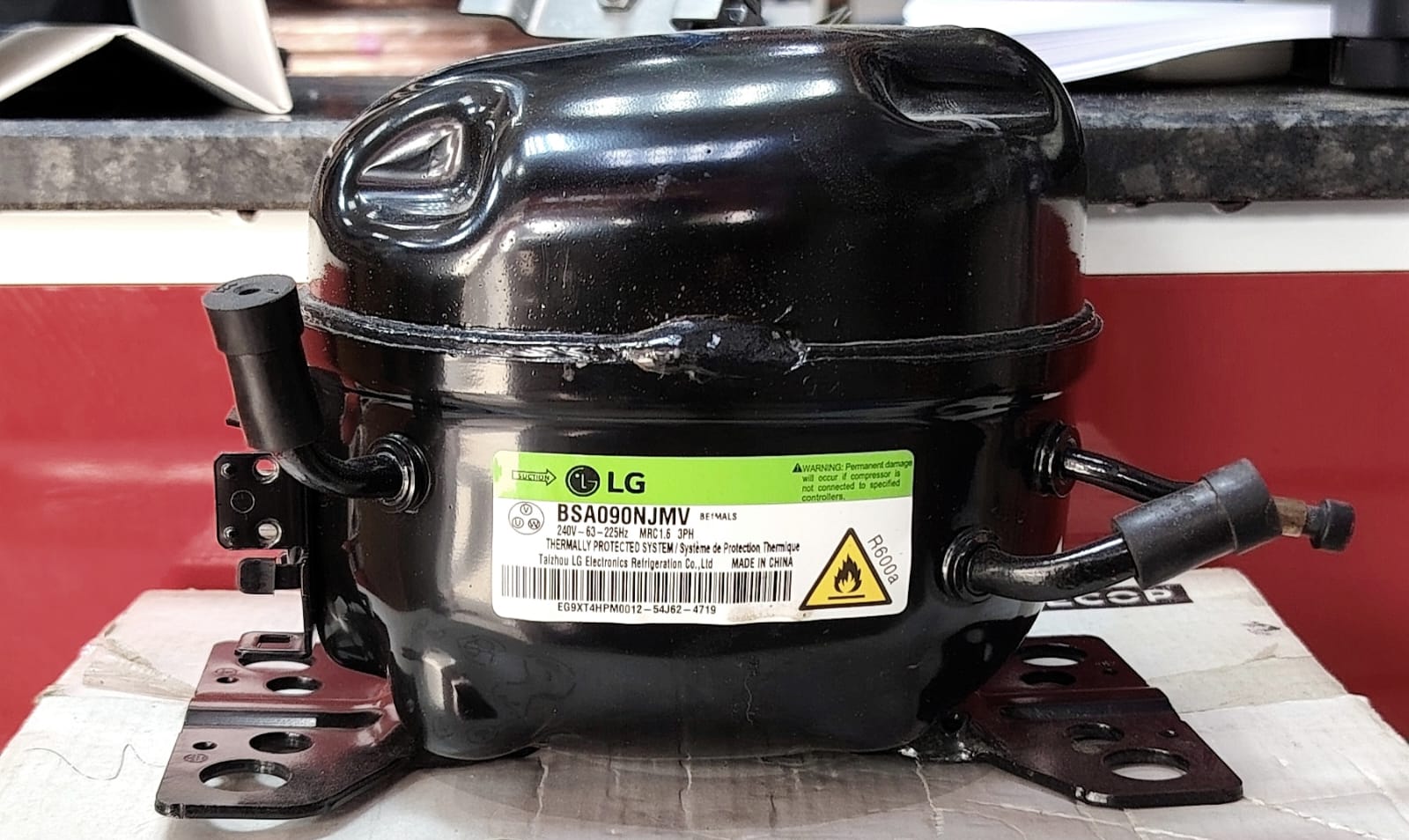
What is the LG BSA090NJMV Compressor?
The LG BSA090NJMV is a variable-speed inverter refrigerator compressor designed for high-efficiency domestic refrigeration systems. Instead of constantly switching ON and OFF like older compressors, it changes its speed according to cooling demand.
The result is:
- Lower electricity consumption
- Quieter operation
- More stable cabinet temperatures
- Longer compressor life when properly installed
This compressor is designed to operate with R600a (Isobutane) refrigerant, which has become one of the most common refrigerants in modern household refrigerators because of its excellent energy efficiency and low environmental impact.
Specifications
Based on the compressor label, here are the key specifications.
| Specification | Details |
|---|---|
| Brand | LG |
| Model | BSA090NJMV |
| Refrigerant | R600a |
| Voltage | 240V |
| Frequency | 63–225 Hz |
| Phase | 3 Phase (Inverter Driven) |
| Compressor Type | Variable Speed Inverter |
| Protection | Thermally Protected |
| Manufacturer | Taizhou LG Electronics Refrigeration Co., Ltd. |
| Country of Manufacture | China |
One thing that catches many technicians by surprise is the 3-phase marking. This does not mean it connects directly to a three-phase electrical supply.
Instead, the refrigerator’s inverter PCB converts standard household AC power into variable-frequency three-phase power for the compressor.
Understanding the Frequency Range
One specification that deserves attention is the operating frequency:
63 Hz to 225 Hz
Unlike conventional compressors that always run at one speed, this inverter compressor adjusts its RPM depending on cooling demand.
For example:
- Low cooling demand → lower frequency
- High cooling demand → higher frequency
- Fast pull-down after door opening → maximum frequency
This variable-speed operation improves efficiency and reduces energy consumption.
Why LG Uses R600a Refrigerant
Over the past several years, I’ve noticed almost every premium household refrigerator shifting toward R600a.
There are several reasons.
Better Energy Efficiency
R600a requires less energy than many older refrigerants.
Environmentally Friendly
Its Global Warming Potential (GWP) is extremely low compared to older refrigerants.
Excellent Cooling Performance
When the refrigeration system is properly charged, R600a provides excellent cooling with relatively small refrigerant charges.
Important Safety Note About R600a
One thing every technician should remember is that R600a is flammable.
That doesn’t mean it’s dangerous during normal operation, but repairs require extra care.
Always:
- Disconnect electrical power before opening the sealed system.
- Never braze near refrigerant without recovering it first.
- Ensure good ventilation.
- Avoid sparks or open flames.
- Use tools suitable for hydrocarbon refrigerants.
Following proper refrigeration service procedures helps keep the work safe.

Common Applications
The LG BSA090NJMV is commonly found in:
- Household refrigerators
- Frost-free refrigerators
- Bottom-freezer refrigerators
- Top-mount refrigerators
- Energy-efficient inverter refrigerators
Manufacturers use this compressor because it balances quiet operation with low energy consumption.
Performance in Daily Use
One thing I’ve noticed while working on inverter refrigerators is how quietly they operate.
Many homeowners think the compressor has stopped because they can’t hear it running.
In reality, it’s simply operating at a lower speed.
Compared with older fixed-speed compressors, the differences are noticeable:
- Less vibration
- Reduced noise
- More consistent temperatures
- Lower electricity bills
- Fewer hard starts
How the Inverter System Works
Here’s a simplified explanation.
- The refrigerator monitors cabinet temperature.
- The control board calculates the cooling requirement.
- The inverter board changes the compressor frequency.
- The compressor speeds up or slows down accordingly.
- The refrigerator maintains a stable temperature without frequent ON/OFF cycling.
This smooth operation reduces wear on the compressor.
Signs the Compressor May Have a Problem
Although the compressor itself is generally reliable, problems can still occur.
Common symptoms include:
Refrigerator Not Cooling
Possible causes:
- Compressor not running
- Inverter PCB fault
- Refrigerant leak
- Blocked capillary tube
Compressor Clicks but Doesn’t Run
This often points toward an inverter control issue rather than compressor failure.
Excessive Noise
Possible causes include:
- Loose mounting bolts
- Internal mechanical wear
- Refrigerant flooding
- Poor installation
High Power Consumption
Potential reasons include:
- Dirty condenser
- Faulty door gasket
- Continuous high-speed operation
- Refrigerant system issues
Basic Diagnostic Steps
Whenever I troubleshoot an inverter refrigerator, I follow a simple process before suspecting the compressor.
Step 1: Check Power Supply
Confirm the refrigerator is receiving proper voltage.
Step 2: Inspect the Inverter Board
Look for:
- Burn marks
- Damaged components
- Loose connectors
Step 3: Verify Compressor Connections
Ensure all wiring is secure and free from corrosion.
Step 4: Measure Input Voltage
Use a quality digital multimeter to verify the inverter board is receiving the correct supply voltage.
Step 5: Check Cooling Performance
Observe:
- Compressor operation
- Condenser temperature
- Evaporator frost pattern
- Cabinet temperature
This systematic approach helps identify whether the issue lies with the compressor, control electronics, or refrigeration circuit.
Common Mistakes to Avoid
I’ve seen several avoidable mistakes when servicing inverter refrigerator compressors.
Replacing the Compressor Too Soon
Many technicians replace the compressor without checking the inverter board first.
In many cases, the compressor is perfectly functional.
Using the Wrong Refrigerant
Never substitute R600a with another refrigerant.
Mixing refrigerants can damage the system and create safety risks.
Overcharging Refrigerant
R600a systems use a very small refrigerant charge. Even adding a few extra grams can affect cooling performance.
Always charge by the manufacturer’s specified weight using an accurate refrigerant scale.
Ignoring Condenser Cleaning
Dust buildup restricts heat transfer.
Cleaning the condenser periodically helps maintain efficiency and reduces compressor workload.
Maintenance Tips
Although refrigerator compressors require little maintenance, the surrounding system benefits from regular care.
I recommend:
- Cleaning condenser coils every 6–12 months.
- Keeping ventilation openings unobstructed.
- Avoiding overloading the refrigerator with warm food.
- Checking door gasket seals for air leaks.
- Maintaining adequate space behind the refrigerator for airflow.
These simple habits help the compressor run more efficiently and may extend its service life.
Is the LG BSA090NJMV Reliable?
From what I’ve seen during repairs, LG inverter compressors like the BSA090NJMV are generally dependable when paired with a healthy control board and a properly sealed refrigeration system.
Most failures attributed to the compressor actually turn out to be caused by issues such as a faulty inverter PCB, refrigerant leaks, or poor maintenance. With clean condenser coils, correct refrigerant charge, and proper ventilation, this compressor can deliver years of quiet, energy-efficient operation.
If you’re considering it as a replacement, always match the original specifications, including refrigerant type, voltage, inverter compatibility, and capacity. Choosing the correct replacement and following recommended installation practices will help ensure reliable cooling performance for years to come.
Frequently Asked Questions (FAQ)
Is the LG BSA090NJMV a fixed-speed compressor?
No. It is a variable-speed inverter compressor that changes its operating speed based on cooling demand.
Which refrigerant does it use?
It is designed exclusively for R600a (Isobutane) refrigerant.
Can it run directly on household AC power?
No. It requires an inverter control board that converts household AC into variable-frequency three-phase power for the compressor.
Is R600a safe?
Yes, when handled correctly. However, it is flammable, so servicing must be performed using proper refrigeration safety procedures and equipment.
Can I replace it with a different compressor model?
Only if the replacement matches the original specifications, including capacity, refrigerant type, voltage, and inverter compatibility. Using an incompatible compressor can reduce efficiency or damage the refrigerator.