
If you’ve ever stood in front of an old air conditioner trying to figure out its cooling capacity, you’re not alone. I still remember replacing a rooftop AC unit where the nameplate had faded so badly that only the BTU rating was readable. The customer kept asking, “Is this a 2-ton unit or a 3-ton unit?” At first, I reached for my phone to calculate it, but after doing it hundreds of times in the field, the formula became second nature. BTU to TON Conversion Formula in HVAC.
Knowing how to convert BTU to TON isn’t just useful for HVAC technicians. Homeowners, contractors, facility managers, and even students often need this calculation when selecting or replacing an air conditioning system.
The good news is that it’s one of the easiest HVAC formulas you’ll ever learn.
What Does BTU Mean?
BTU stands for British Thermal Unit. It measures the amount of heat an air conditioner can remove from a room in one hour.
Simply put:
- Higher BTU = More cooling capacity
- Lower BTU = Less cooling capacity
When shopping for air conditioners, you’ll often see capacities like:
- 9,000 BTU
- 12,000 BTU
- 18,000 BTU
- 24,000 BTU
- 36,000 BTU
These numbers indicate how much heat the system can remove every hour.
What Does “Ton” Mean in HVAC?
Many people think “ton” refers to the weight of an air conditioner. It doesn’t.
In HVAC, 1 ton is a unit of cooling capacity.
Historically, it comes from the amount of heat required to melt one ton of ice over a 24-hour period.
That cooling capacity equals:
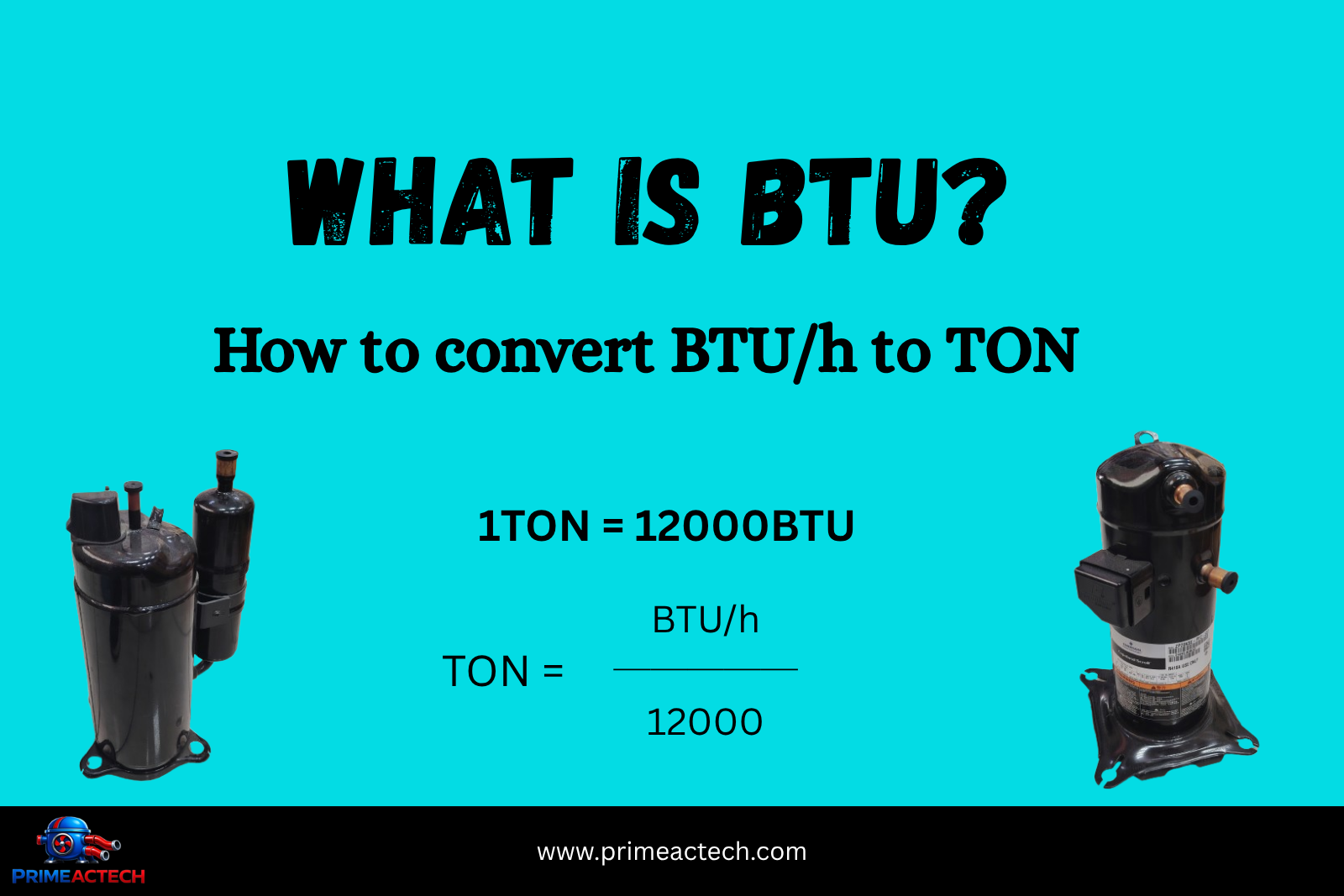
1 TON = 12,000 BTU/hr
This is the standard used worldwide in residential and commercial air conditioning.
BTU to TON Conversion Formula
The conversion formula is very simple:
TON = BTU ÷ 12,000
That’s all there is to it.
If you know the BTU rating, divide it by 12,000 to find the cooling capacity in tons.
Examples of BTU to TON Conversion
Here are some common HVAC conversions you’ll encounter.
| BTU/hr | Formula | Capacity |
|---|---|---|
| 9,000 | 9,000 ÷ 12,000 | 0.75 Ton |
| 12,000 | 12,000 ÷ 12,000 | 1 Ton |
| 18,000 | 18,000 ÷ 12,000 | 1.5 Ton |
| 24,000 | 24,000 ÷ 12,000 | 2 Ton |
| 30,000 | 30,000 ÷ 12,000 | 2.5 Ton |
| 36,000 | 36,000 ÷ 12,000 | 3 Ton |
| 42,000 | 42,000 ÷ 12,000 | 3.5 Ton |
| 48,000 | 48,000 ÷ 12,000 | 4 Ton |
| 60,000 | 60,000 ÷ 12,000 | 5 Ton |
This table has saved me countless minutes while checking equipment on-site.
Quick BTU to TON Conversion Chart
| Cooling Capacity (BTU/hr) | HVAC Tons |
|---|---|
| 6,000 | 0.5 Ton |
| 9,000 | 0.75 Ton |
| 12,000 | 1 Ton |
| 15,000 | 1.25 Ton |
| 18,000 | 1.5 Ton |
| 21,000 | 1.75 Ton |
| 24,000 | 2 Ton |
| 30,000 | 2.5 Ton |
| 36,000 | 3 Ton |
| 42,000 | 3.5 Ton |
| 48,000 | 4 Ton |
| 54,000 | 4.5 Ton |
| 60,000 | 5 Ton |
| 72,000 | 6 Ton |
| 90,000 | 7.5 Ton |
| 120,000 | 10 Ton |
Step-by-Step BTU to TON Calculation
Let’s say you’re looking at an outdoor condenser labeled 36,000 BTU/hr.
Step 1: Find the BTU Rating
Read the equipment nameplate.
Example:
36,000 BTU/hr
Step 2: Use the Formula
TON = BTU ÷ 12,000
Step 3: Calculate
36,000 ÷ 12,000 = 3 Tons
Your system is a 3-ton air conditioner.
Real-World Example
A homeowner once called me because they wanted to replace an old split AC but weren’t sure of its size. The model number wasn’t very clear, but the manual listed the cooling capacity as 24,000 BTU/hr.
Using the formula:
24,000 ÷ 12,000 = 2 Tons
That quick calculation helped us choose a compatible replacement without guessing. It also made it easier to compare different brands, since some advertise in BTU while others list capacity in tons.
Why HVAC Technicians Use Tons Instead of BTU
Manufacturers often describe equipment differently.
For example:
- Window AC units usually use BTU.
- Mini split systems often show BTU.
- Central air conditioners are commonly rated in tons.
- Commercial rooftop units may display both.
Being able to convert between the two helps when comparing equipment or verifying that a replacement matches the original system. BTU to TON Conversion Formula in HVAC.
BTU vs TON
| BTU | TON |
|---|---|
| Measures cooling capacity | Measures cooling capacity |
| Larger numerical value | Smaller numerical value |
| Common on room AC units | Common on central AC systems |
| Measured in BTU/hr | 1 Ton = 12,000 BTU/hr |
They describe the same thing using different units.
Common Air Conditioner Sizes
Here are some of the most common residential AC sizes.
| HVAC Size | BTU/hr |
|---|---|
| 1 Ton | 12,000 |
| 1.5 Ton | 18,000 |
| 2 Ton | 24,000 |
| 2.5 Ton | 30,000 |
| 3 Ton | 36,000 |
| 4 Ton | 48,000 |
| 5 Ton | 60,000 |
If you’re comparing products online, this table makes it easy to switch between the two ratings.
Common Mistakes to Avoid
Over the years, I’ve noticed a few mistakes that come up again and again.
Assuming Bigger Is Always Better
A larger AC cools faster, but it may cycle on and off too often. That can lead to poor humidity control, uneven temperatures, and unnecessary energy use.
Mixing BTU and Watts
Cooling capacity (BTU) and electrical power (watts) are different measurements. One tells you how much cooling the system provides, while the other indicates how much electricity it uses.
Forgetting the “/hr”
When you see BTU in HVAC, it almost always means BTU per hour (BTU/hr). That’s the standard way cooling capacity is expressed.
Guessing the System Size
Don’t estimate the size based only on the home’s square footage or the appearance of the outdoor unit. Check the equipment nameplate or the manufacturer’s specifications whenever possible.
Can You Size an Air Conditioner Using BTU Alone?
Not always.
Fan Power (kW)
Power = (CFM × 60 Room Volume
BTU gives you the cooling capacity, but choosing the right air conditioner also depends on factors like:
- Room size
- Ceiling height
- Insulation quality
- Window area
- Sun exposure
- Local climate
- Number of occupants
- Heat-generating appliances
That’s why HVAC professionals often perform a proper load calculation before recommending a new system, especially for whole-house installations.
Helpful Tip for Reading Model Numbers
Many HVAC model numbers include the capacity.
Examples:
- 018 = 18,000 BTU = 1.5 Ton
- 024 = 24,000 BTU = 2 Ton
- 030 = 30,000 BTU = 2.5 Ton
- 036 = 36,000 BTU = 3 Ton
- 048 = 48,000 BTU = 4 Ton
- 060 = 60,000 BTU = 5 Ton
While not every manufacturer follows this pattern, it’s common enough that it can help you identify the system size quickly.
Frequently Asked Questions
Is 12,000 BTU equal to 1 ton?
Yes. 12,000 BTU/hr equals 1 ton of cooling capacity.
How many BTU are in a 2-ton AC?
A 2-ton air conditioner provides 24,000 BTU/hr of cooling.
How do I convert BTU to tons?
Use this simple formula:
TON = BTU ÷ 12,000
Is a 24,000 BTU mini split a 2-ton unit?
Yes. A 24,000 BTU mini split is equal to 2 tons.
Is a 36,000 BTU air conditioner 3 tons?
Yes. Dividing 36,000 by 12,000 gives 3 tons.
Final Thoughts
The BTU to TON conversion formula is one of those HVAC basics that’s worth memorizing because you’ll use it often. Once you remember that 1 ton equals 12,000 BTU/hr, converting between the two becomes quick and easy.
Whether you’re replacing an old air conditioner, comparing equipment specifications, or learning HVAC fundamentals, this simple calculation can help you understand cooling capacity with confidence. And if you’re selecting a new system, treat the conversion as the starting point—not the final decision. Matching the unit to the building’s actual cooling needs is what delivers the best comfort, efficiency, and long-term performance.